Aluminum formwork, widely known as Mivan shuttering, has revolutionized modern high-rise construction by replacing traditional timber and plywood formwork with high-speed, monolithic concrete pouring. However, the operational efficiency, surface finish, and lifecycle of expensive aluminum panels depend heavily on one crucial material: Mivan shuttering oil (form release agent).
This ultimate guide covers the technical fundamentals, working procedures, economic benefits, and selection criteria for high-performance release agents in aluminum formwork systems.

Mivan shuttering oil is a specially formulated chemical or mineral-based form release agent engineered to create a physical and chemical barrier between aluminum formwork panels and wet concrete.
Unlike traditional shuttering oils used on plywood or timber, Mivan shuttering oil is non-reactive or mildly reactive with aluminum. It prevents chemical bonding (such as aluminum oxide reactions with fresh concrete alkalinity), ensures smooth surface detachment, and prevents concrete slurry from sticking to the aluminum faces.
Aluminum formwork systems are selected for large-scale residential and commercial projects due to five structural and operational advantages:
An aluminum formwork assembly consists of four interconnected categories of modular parts:
| Component Category | Description |
|---|---|
| Wall Panels | Form the vertical load-bearing walls and columns (Wall Panels, Rockers, Kicker Panels). |
| Beam & Deck Components | Support horizontal spans and floor slabs (Deck Panels, Soffit Lengths, Beam Bar Panels). |
| Connectors & Hardware | Lock the panels tight to resist hydraulic concrete pressure (Wedges, Pin Assembly, Wall Ties, Alignment Bars). |
| Support Systems | Provide vertical load bearing during concrete curing (Prop Heads, Adjustable Single Props, Deck Props). |
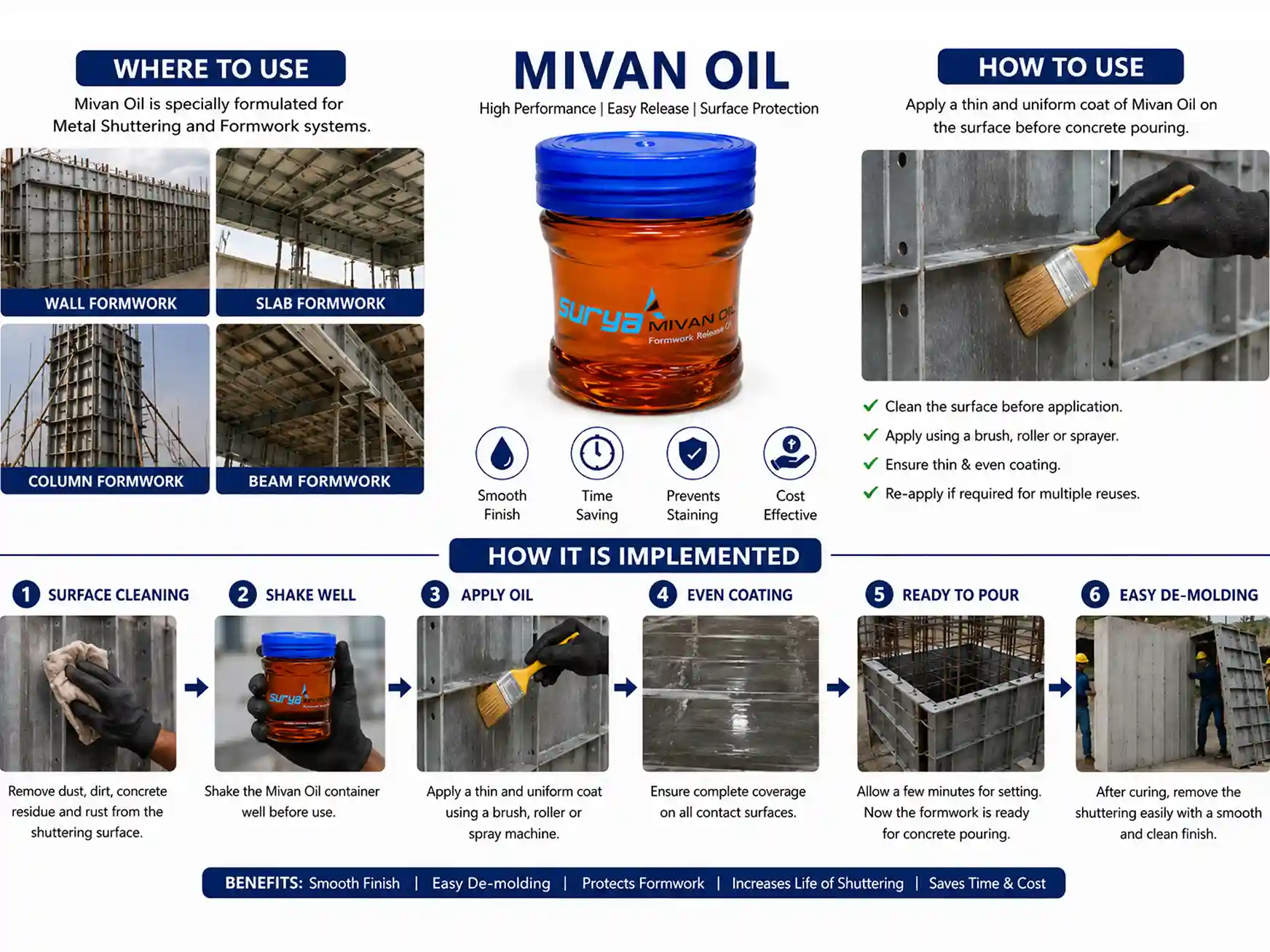
To achieve optimal surface quality and ensure panel longevity, follow this 6-step site workflow:
Clear the floor slab, check line alignments using total stations, and mark exact wall locations. Clean kickers thoroughly to ensure vertical plumbness.
Erect wall panels sequentially starting from corners. Connect adjacent panels using pins and wedges, maintaining strict level accuracy.
Fix steel rebar cages inside the wall cavities. Install internal MEP conduits, electrical junction boxes, and plumbing lines prior to closing the inner shuttering face.
Spray or brush a thin, uniform layer of Mivan shuttering oil over all inner contact faces of the panels.
Critical Note: Apply the release agent after cleaning the panels and before final alignment. Avoid over-application or pooling, as excess oil can stain concrete surfaces or impede paint adhesion later.
Pour self-compacting concrete (SCC) or high-flow pumpable concrete (typically M30 to M50 grade). Use needle vibrators judiciously to prevent panel displacement while ensuring complete compaction around dense reinforcement.
After 12–24 hours (depending on ambient temperature and mix design), remove pins, wedges, and wall panels. Leave vertical props in place under slabs for the full curing duration while transferring panels to the next floor.
Using a high-grade, system-specific release agent delivers measurable site benefits:
While aluminum formwork is highly efficient, it presents specific operational constraints:
| Limitation | Technical Reason | Mitigation Strategy |
|---|---|---|
| High Initial Investment | Aluminum panels require custom manufacturing and high upfront capital expenditure. | Best suited for projects with repetitive layouts (minimum 100+ units). |
| Inflexible Architectural Changes | Once manufactured, panel dimensions cannot be altered easily on site. | Requires complete architectural design freeze before panel fabrication. |
| Thermal Expansion & Heat | Aluminum conducts heat rapidly, accelerating initial concrete setting during hot weather. | Regulate concrete temperature and use optimized shuttering oil barriers. |
| Staining Potential | Low-quality or mineral-heavy oils react with aluminum to create dark surface stains. | Use specialized water-emulsifiable or vegetable-oil-based release agents. |
Mivan shuttering performs best under the following project parameters:
Mivan shuttering oil costs vary based on chemical composition, dilution ratios, and performance metrics:
| Type of Release Agent | Base Chemistry | Estimated Price Range (per Liter) | Typical Coverage Area |
|---|---|---|---|
| Mineral Oil Based | Refined petroleum fractions + additives | ₹60 – ₹110 | 25 – 35 sq. meters / L |
| Emulsified / Water-Based | Water-in-oil emulsion with surfactant | ₹80 – ₹150 | 40 – 60 sq. meters / L (diluted) |
| Vegetable / Synthetic Bio-Oil | Natural fatty acids & biodegradable esters | ₹140 – ₹240 | 50 – 70 sq. meters / L |
| Feature | Mivan (Aluminum) Formwork | Conventional Plywood / Timber | Steel Centering Formwork |
|---|---|---|---|
| Speed of Construction | High (4–7 day cycle/floor) | Slow (14–21 day cycle/floor) | Moderate (10–14 day cycle/floor) |
| Number of Reuses | 250 – 300+ cycles | 10 – 15 cycles | 80 – 100 cycles |
| Concrete Finish | Smooth, fair-faced (no plaster needed) | Requires plastering layer | Good finish, minor joint seams |
| Initial Cost | Very High | Low | Moderate |
| Specialized Oil Need | Requires dedicated Aluminum Release Agent | Standard Engine/Waste/Mineral Oil | Mineral-based Rust Inhibiting Oil |
| Structural Integrity | Monolithic (Jointless) | Column-Beam-Slab (Staged) | Staged or Semi-Monolithic |
Selecting the right release agent determines how effectively high-cost aluminum panels are protected. Surya Engineering Shuttering Oil is formulated specifically to address the physical and chemical demands of modern aluminum formwork.
Key features include:
A: Mivan shuttering oil is a specialized chemical release agent applied to aluminum formwork panels before concrete pouring. It prevents wet concrete from bonding to aluminum, enabling clean stripping and protecting panels from chemical abrasion.
A: Shuttering oil is a single-use consumable item applied before every single concrete pour. However, a single set of Mivan aluminum panels treated with high-quality oil can be reused 250 to 300+ times.
A: Substandard oil causes concrete paste to stick to aluminum faces, leading to concrete chipping during de-shuttering, dark staining, surface bug-holes, and accelerated chemical corrosion of the formwork.
A: A T-Plate (or T-Beam component) is a structural connecting panel used at the intersection of walls and beam bottoms or slab soffits. It provides horizontal load transfer and maintains exact 90-degree alignment at wall-slab junctions.
A: "Mivan" is derived from Mivan Company Ltd., a Malaysian construction technology firm that popularized modular aluminum formwork systems in Europe and Asia during the late 1970s and 1980s.
A: Standard aluminum formwork panels feature an extruded skin plate thickness of 4 mm to 4.5 mm, backed by 6 mm structural stiffener ribs for high rigidity against wet concrete pressure.
A: Mivan systems utilize high-flow, pumpable concrete—frequently Self-Compacting Concrete (SCC)—with slump flows between 600 mm to 700 mm and target compressive strengths ranging from M30 to M60.
A: Mivan systems use Adjustable Heavy-Duty Single Props equipped with drop heads or prop heads. These allow slab panels to be stripped early (after 24–36 hours) while leaving vertical support props locked under the curing slab for structural safety.
| Region | Cities Covered |
|---|---|
| West | Mumbai, Pune, Surat, Ahmedabad, Rajkot, Kolhapur |
| South | Bangalore, Hyderabad, Chennai, Mysore, Vizag, Hubli |
| North | Delhi, Kota, Udaipur |
| East & Central | Kolkata, Raipur, Patna, Rourkela, Indore, Vijayawada |
By choosing Surya Engineering, you are selecting a partner who understands the local needs of the Indian construction industry and provides the technical expertise to deliver world-class flooring solutions.
Contact SURYA Engineering for expert guidance on selecting the right release agent for your aluminium formwork projects.
Get in Touch