Surya Engineering · PAN India Manufacturer & Supplier

Cold Forged
Rebar Coupler

High-performance Cold Forged Rebar Couplers for strong, reliable, and permanent mechanical connections between reinforcement bars in RCC construction, bridges, metro rail, tunnels, dams, and infrastructure projects.

Request Bulk Quote →
12–40mm
Rebar Diameter Range
IS 16172
Compliance Standard
PAN
India Supply Network
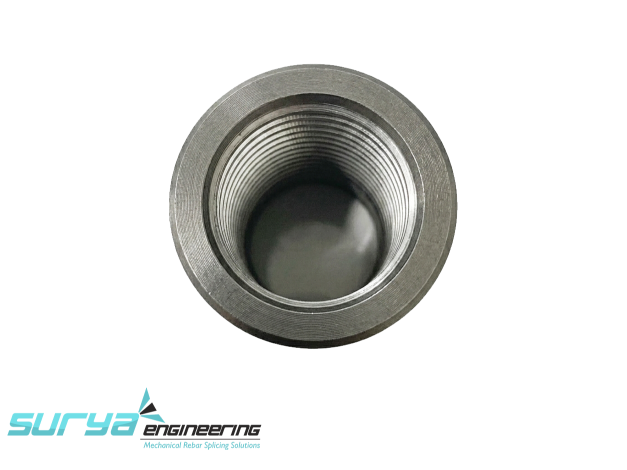
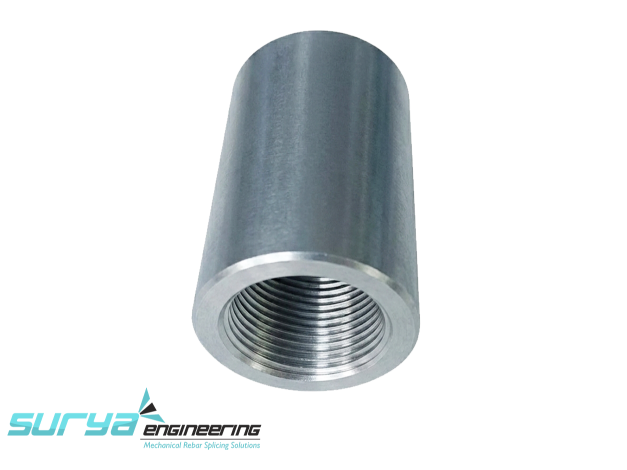
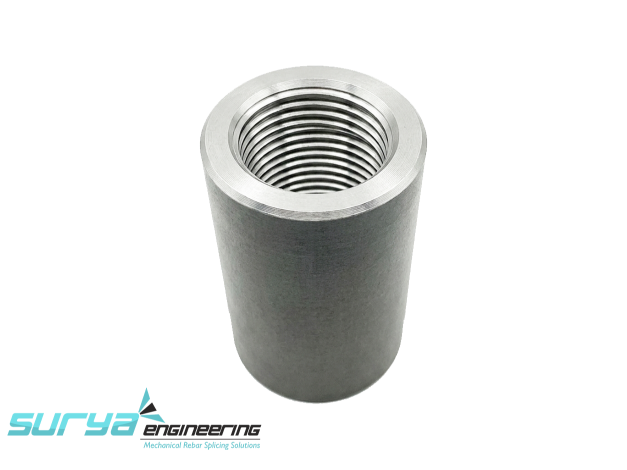
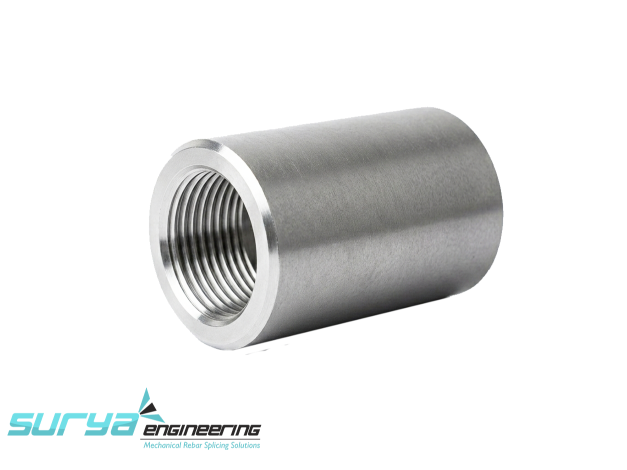
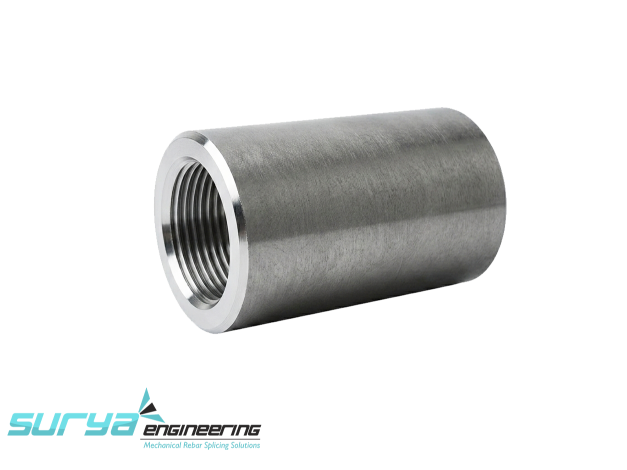
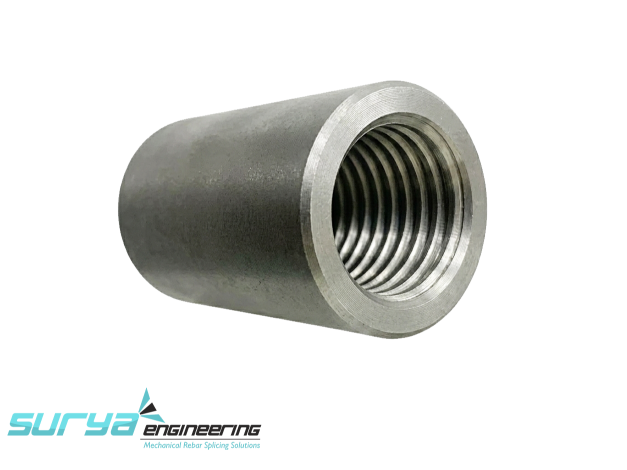
Cold Forged Rebar Coupler by Surya Engineering – TMT bar coupler for RCC construction
⚙️ Cold Forged · Parallel Thread

What is a Cold Forged Rebar Coupler?

A Cold Forged Rebar Coupler is a mechanical reinforcement bar joining system manufactured through a cold forging process, where steel is shaped under high pressure at room temperature to improve its strength and grain structure.

The coupler is internally threaded after forging and is used to connect two reinforcement bars securely without lap splicing. Cold forging increases dimensional accuracy, improves mechanical properties, and enhances load-bearing performance.

Cold forged couplers are commonly used as a replacement for conventional lap joints because they reduce steel consumption, improve reinforcement continuity, and provide better concrete flow in congested reinforcement zones.

Why Cold Forged Rebar Couplers are Used?

Modern RCC structures require reinforcement connections capable of transferring tensile, compressive, and seismic loads effectively.

♻️
Reduces Steel Consumption
Cold forged couplers eliminate long lap lengths and reduce unnecessary steel usage.
  • Lower reinforcement cost
  • Reduced material wastage
  • Optimized structural design
💪
Improves Structural Strength
The coupler creates a direct load path between reinforcement bars.
  • Better load transfer
  • Improved tensile performance
  • Enhanced structural reliability
🌊
Reduces Reinforcement Congestion
Lap joints often create excessive steel density inside columns and beams.
  • Better concrete flow
  • Improved compaction
  • Reduced honeycombing risk
Faster Construction
Coupler installation is significantly faster than conventional lap splicing methods.
  • Reduced labor requirement
  • Faster project completion
  • Improved productivity
🏗️
Suitable for High-Rise Structures
Cold forged couplers are extensively used in vertical reinforcement systems.
  • Easier column construction
  • Better reinforcement management
  • Reduced congestion in core walls

Technical Specifications of Cold Forged Rebar Coupler

ParameterSpecification
Product NameCold Forged Rebar Coupler
MaterialHigh-Grade Carbon Steel
Manufacturing ProcessCold Forging
Rebar Diameter Range12mm – 40mm
Thread TypeParallel Thread
Tensile StrengthGreater than Parent Rebar
Surface FinishNatural / Zinc Coated
InstallationThreaded Connection
ApplicationRCC Construction
ReusabilityNo
Corrosion ResistanceOptional Coating Available

Why Cold Forging is Better than Conventional Machining?

Cold forging improves the internal grain flow of steel, resulting in higher strength and better fatigue resistance compared to couplers manufactured through conventional machining methods.

Parameter Cold Forged Coupler Conventional Machined Coupler
Material StrengthHigherStandard
Grain StructureImprovedInterrupted
Fatigue ResistanceBetterModerate
Dimensional AccuracyHighModerate
DurabilityExcellentGood
Structural PerformanceSuperiorStandard

Types of Cold Forged Rebar Couplers

Different configurations are available to accommodate various structural conditions and reinforcement requirements.

Standard
Standard Coupler
Used for joining reinforcement bars of the same diameter.

Applications

  • Columns
  • Beams
  • Slabs
  • Foundations
Transition
Transition Coupler
Used for connecting rebars of different diameters.

Applications

  • Structural modifications
  • Design changes
  • Expansion projects
Position
Position Coupler
Used where reinforcement bars cannot rotate.

Applications

  • Beam-column junctions
  • Congested reinforcement zones
  • Retrofit projects
Weldable
Weldable Coupler
Designed where one end is welded to structural steel.

Applications

  • Steel-to-concrete structures
  • Industrial plants
  • Infrastructure projects

Applications of Cold Forged Rebar Couplers

IndustryApplication
High-Rise BuildingsVertical reinforcement splicing
BridgesDeck and pier reinforcement
Metro Rail ProjectsTunnel reinforcement
DamsHeavy RCC structures
Marine StructuresCorrosion-sensitive applications
Industrial ConstructionFactory foundations
AirportsInfrastructure development
FlyoversReinforcement continuity

Installation Process of Cold Forged Rebar Coupler

Proper installation is essential for achieving full tensile strength and long-term structural performance.

01
Rebar End Preparation
Cut reinforcement bars square and prepare threads using approved threading machines.
02
Thread Inspection
Check thread dimensions before installation.
03
Go/No-Go Gauge Test
Verify thread accuracy using calibrated Go/No-Go gauges. This test confirms that the threaded reinforcement bar and coupler meet dimensional requirements before installation.
  • Ensures thread accuracy
  • Improves fitment quality
  • Reduces installation errors
  • Maintains consistent performance
04
Coupler Installation
Thread the coupler onto the reinforcement bar.
05
Tightening
Tighten according to installation specifications.
06
Final Inspection
Verify engagement length, alignment, and fitment.

Testing Standards of Cold Forged Rebar Coupler

Surya Engineering Cold Forged Rebar Couplers undergo rigorous testing to ensure compliance with Indian and international standards.

🇮🇳
IS 16172:2023
Mechanical Splicing of Reinforcing Bars
🌐
ISO 15835
Mechanical Splices for Reinforcing Bars
🌐
ASTM A1034
Mechanical Splice Performance Testing
🌐
ACI 318
Structural Concrete Requirements
🌐
BS 8110
Structural Use of Concrete
Static Tensile Test
Verifies ultimate tensile strength and confirms that the coupler develops strength equal to or greater than the parent reinforcement bar.
Slip Test
Measures axial movement between rebar and coupler under load.
Cyclic Tensile Test
Evaluates performance under repeated loading conditions.
Fatigue Test
Assesses long-term durability under dynamic loading.

Go/No-Go Gauge Test

The Go/No-Go Gauge Test is one of the most important quality inspections for threaded couplers.

The "Go" side must pass completely through the thread profile, while the "No-Go" side must not pass beyond the permissible limit.

✅ "Go" SideMust pass completely through the thread profile.
❌ "No-Go" SideMust not pass beyond the permissible limit.

This test helps ensure:

  • Accurate thread dimensions
  • Proper coupler engagement
  • Reliable tensile performance
  • Consistent manufacturing quality
  • Compliance with quality standards

Advantages of Cold Forged Rebar Coupler

💪
Higher Tensile Strength
♻️
Reduced Steel Consumption
Faster Installation
🌊
Improved Concrete Flow
📉
Reduced Reinforcement Congestion
🔩
Better Fatigue Resistance
🏛️
Enhanced Structural Integrity
Long Service Life
Consistent Manufacturing Quality
🌍
Suitable for Seismic Applications
💰
Cost-Effective Construction Solution

PAN India Industrial Supply & Service Network

Surya Engineering supplies Cold Forged Rebar Couplers, MBT Couplers, Mechanical Rebar Couplers, Bolted Type Couplers, Rebar Safety Products, and Construction Accessories across major industrial and infrastructure hubs in India.

Surya Engineering supports contractors, infrastructure developers, EPC companies, construction firms, government projects, metro rail projects, bridge construction, industrial facilities, and RCC construction projects with reliable product supply, technical assistance, and timely delivery across India.

🌄 North India
Delhi NCR, Noida, Gurugram, Faridabad, Ghaziabad, Chandigarh, Jaipur, Lucknow, Kanpur, Varanasi, Ludhiana, Amritsar, and Jalandhar.
🌅 West India
Mumbai, Pune, Nashik, Navi Mumbai, Thane, Ahmedabad, Vadodara, Surat, Rajkot, Bhavnagar, Indore, Bhopal, Nagpur, and Aurangabad.
🌞 South India
Bengaluru, Chennai, Hyderabad, Coimbatore, Mysore, Visakhapatnam, Vijayawada, Kochi, Thiruvananthapuram, Hubli, and Mangalore.
🌿 East India
Kolkata, Howrah, Bhubaneswar, Cuttack, Guwahati, Patna, Ranchi, Jamshedpur, and Dhanbad.
🗺️ Central India & Other Regions
Raipur, Prayagraj, Agra, Bareilly, Siliguri, Pondicherry, and Goa.

Frequently Asked Questions

What is the difference between a cold forged coupler and a machined coupler? +
Cold forged couplers are manufactured through a forging process that improves steel grain structure and strength, whereas machined couplers are produced by removing material from steel bars.
Why are cold forged couplers preferred in high-rise buildings? +
They reduce reinforcement congestion, improve structural continuity, and allow better concrete compaction in heavily reinforced zones.
What rebar sizes are available? +
Cold forged couplers are generally available for reinforcement bars ranging from 12mm to 40mm.
Do cold forged couplers comply with IS 16172? +
Yes. Quality cold forged couplers are tested according to IS 16172 and other international standards.
Is Go/No-Go Gauge Testing important? +
Yes. Go/No-Go Gauge Testing verifies thread accuracy and ensures proper coupler engagement before installation.
Can cold forged couplers replace lap splicing? +
Yes. In many RCC and infrastructure projects, cold forged couplers are used as a superior alternative to conventional lap joints.

Get Heavy Duty Cold Forged Rebar Couplers from Surya Engineering

12mm–40mm Rebar Diameter · High-Grade Carbon Steel · IS 16172:2023 Compliant · PAN India Supply

Request a Quote →